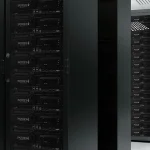
Cardiff University has deployed 90 Lenovo ThinkSystem servers, with Logicalis technology, to support high-performance computing (HPC) research. The university’s Advanced Research Computing @Cardiff (ARCCA) service worked with Logicalis and the Lenovo ThinkSystem platform to boost the capabilities of its Hawk HPC cluster by up to 100%. The HPC will be used to support research into the origins of the universe and star formation.
Lenovo has provided 75 Lenovo ThinkSystem SR645 servers ahead of the fourth two-year gravitational wave detection run of the Laser Interferometer Gravitational-Wave Observatory (LIGO) Scientific Collaboration. The servers offer a minimum performance boost of 46% compared with a traditional HPC environment using identical hardware. According to Lenovo, for some applications, the new servers double the compute performance available to researchers. This uplift in performance enables researchers to process detection events and share data faster.
The hardware comprises Lenovo ThinkSystem SR645 servers powered by AMD Epyc processors, which connect to the Hawk cluster using Nvidia ConnectX-6 connectivity via Ubiquity, an open source cluster management tool provided by Logicalis.
Stephen Fairhurst, head of the gravity exploration institute at Cardiff University, said: “We are getting even greater per-core performance than we expected. Crucially, the new cluster was up and running in time for the latest LIGO observing run. We can now process detection events faster and can share the data with astronomers sooner, helping them locate sources of the signals more easily.”
A second research group at Cardiff University studying star formation, led by Royal Society University research fellow Ana Duarte Cabral, will use 15 Lenovo ThinkSystem SR630 servers with two Lenovo ThinkSystem SR650 servers for storage. Funded by the Royal Society, the group’s research focuses on the creation of stars in spiral galaxies like our own Milky Way, requiring computationally demanding simulations of full galaxies.
“We are getting even greater per-core performance than we expected. We can now process detection events faster and can share the data with astronomers sooner, helping them locate sources of the signals more easily” Stephen Fairhurst, Cardiff University
Commenting on the new HPC setup, Cabral said: “The new nodes will allow us to cascade down from the scale of entire galaxies to the scale of specific star-forming regions. With a dedicated cluster, we can significantly increase the amount of data we can collect.”
The technical implementation provides simultaneous multi-threading, where Ubiquity is used to integrate the Lenovo hardware into the Hawk cluster. This has allowed ARCCA to automate management tasks, allowing research software engineers to focus their efforts on science. According to Lenovo, the configuration balances price to performance when dealing with high-throughput computing and parallelised workloads.
Discussing the benefits of Ubiquity, Martyn Guest, director of Advanced Research Computing at Cardiff University, said: “We wanted to integrate the new computer resource with the existing Hawk cluster. When Logicalis showed us the capabilities of Ubiquity, we were convinced our goal was achievable. Our ability to plug advanced computing equipment into a professionally managed HPC environment has allowed our research groups to secure R&D funding in Wales.”
Source is ComputerWeekly.com
CrowdStrike has been granted a motion to dismiss a consumer class action lawsuit brought by shareholders who were affected by the...
Dit bericht verscheen eerder bij maincubes
Data centers are entering a new era. The explosive growth of AI and highperformance computing (HPC) workloads is pushing...
Source is ComputerWeekly.com
Microsoft is calling on more technology companies to “pay their own way” when covering the electricity costs associated with running artificial...
Dit bericht verscheen eerder bij maincubes
Langfristige Finanzierung unterstützt den Ausbau einer rund 400-MW-Rechenzentrumsplattform für Cloud-, KI- und öffentliche AuftraggeberFrankfurt am Main, 13. Januar 2026...